
Stick-Built Curtain Wall
Stick-built curtain wall for Ghana: mullions, transoms and glazing assembled piece-by-piece on site — flexible, site-tolerant, and performance-tested to ASTM E283 (air), E331 (water) and E330 (structural wind load). Facade Ghana, since 1982.
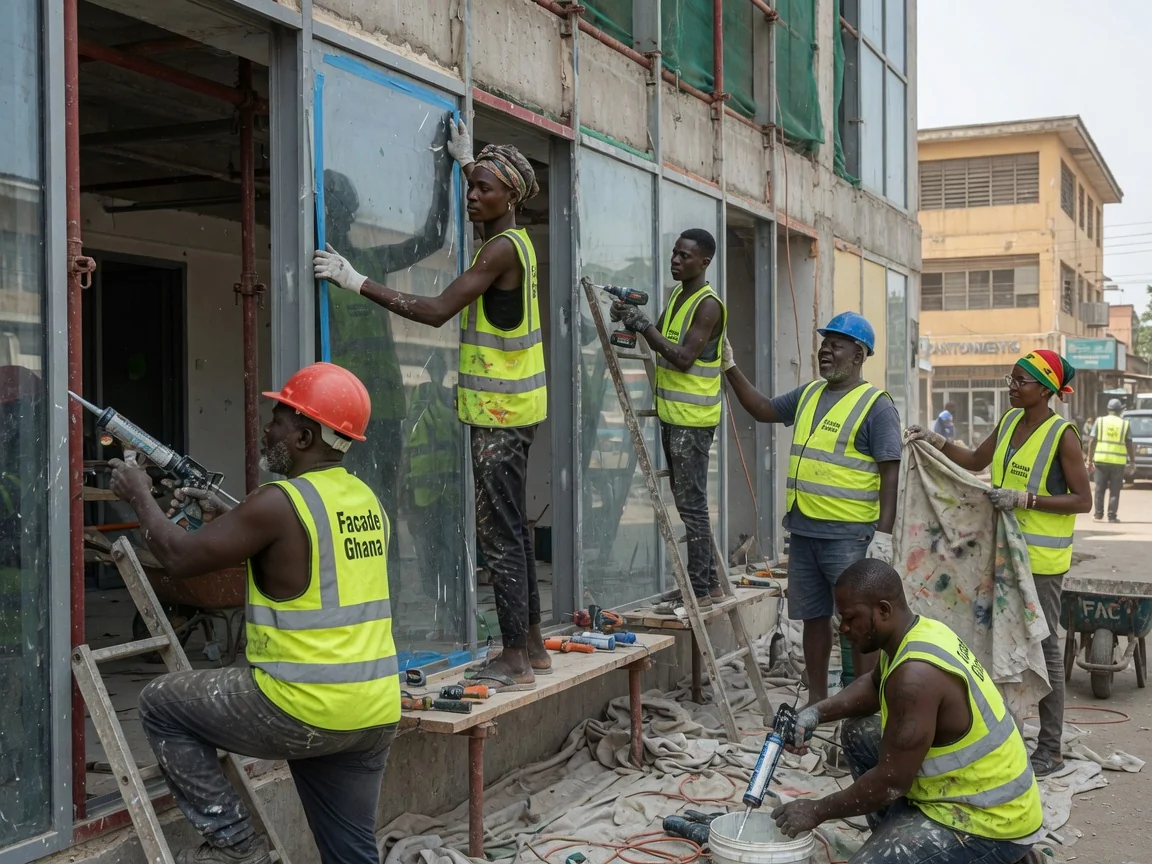
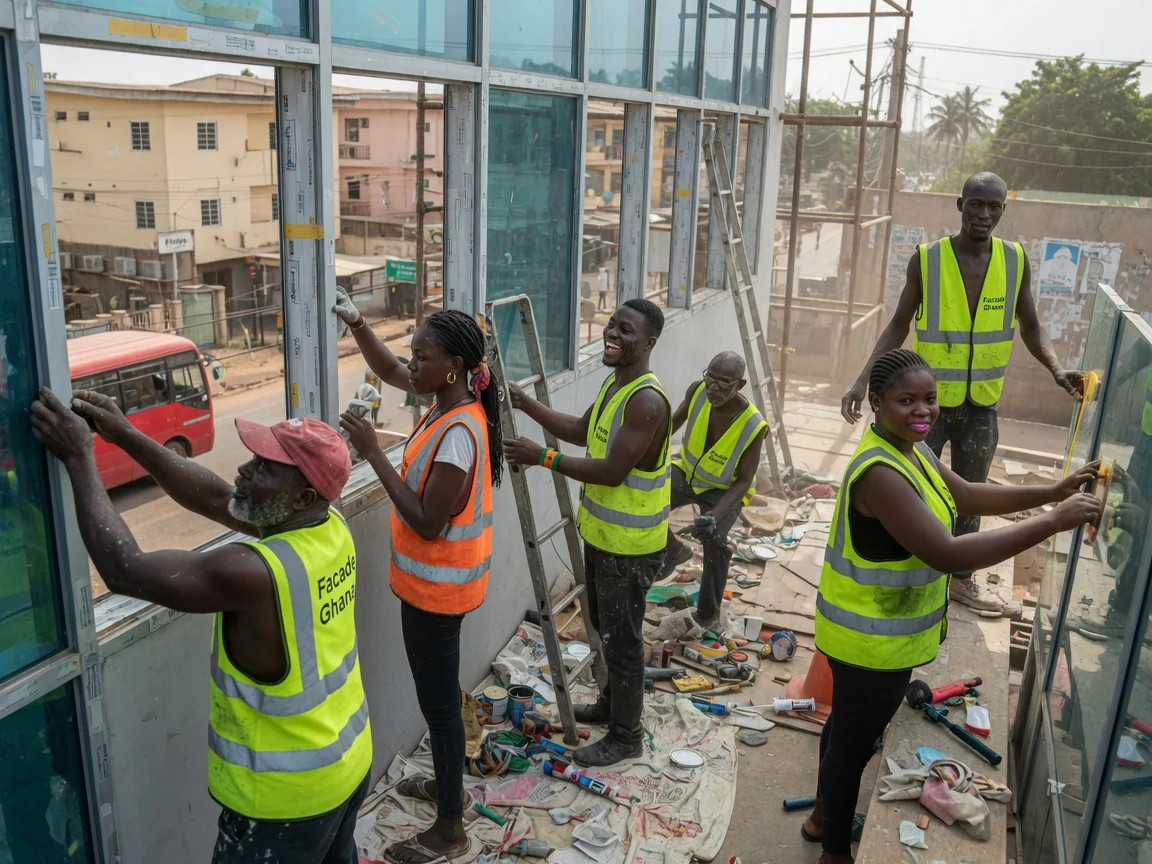
A stick-built curtain wall is a non-load-bearing aluminium envelope assembled piece-by-piece on site — vertical mullions, horizontal transoms, then glass and infill panels glazed in and sealed. It carries no building load except its own weight and the wind, which it transfers back to the floor slabs. Facade Ghana has engineered and installed performance-tested façades across Ghana since 1982, and our position is simple: the envelope is engineered to the building, tested to standard, and handed over in writing.
Why the Stick System Still Wins on the Right Building
The stick system is the original curtain-wall method, and it remains the right answer for a large share of buildings. Because it is built up from individual components on site, it tolerates the real dimensions of a real structure — slab edges are never perfectly true, and a stick system absorbs that. It needs no expensive factory tooling or unitising line, so it carries a lower set-up cost; and it handles irregular elevations, lower- and mid-rise heights, and phased programmes that a unitised line would struggle to justify. The trade-off is that it is erected and sealed in place, so it is slower and more weather-dependent than dropping in factory-finished units.
Choosing Stick-Built vs Unitised
Specify a stick-built system when the building is lower- or mid-rise, the elevation is irregular, access from the slab edge is straightforward, and the programme can absorb on-site assembly. Move to a unitised system when the building is a high-rise tower, the programme demands fast vertical install, and factory-controlled quality and weather-sealing at the interlocks are worth the set-up cost. The decision is made against height, programme and access — not against a single rate.
Stick-Built Curtain Wall Systems
Mullion-and-Transom (Captured) System
The core stick system: aluminium mullions and transoms form a visible grid, and the glass is held by pressure plates and capping. Robust, economical, and the default for lower- and mid-rise commercial work.
Structural-Silicone-Glazed (SSG) Stick System
The glass is bonded to the framing with structural silicone so the external face reads as a flush glass plane with no visible cappings — a stick system delivering a frameless aesthetic. Detailing and QA on the silicone bondline are critical.
Thermally Broken / Solar-Control Stick System
Mullions and transoms incorporate a thermal break, and the glazing is specified for solar control — the right build for Ghana’s heat load, reducing cooling demand on the building behind the façade.
Stick-Built vs Unitised — Compared
| Stick-built | Unitised | |
|---|---|---|
| Assembly | Piece-by-piece on site | Factory-assembled storey-high units |
| Best for | Lower / mid-rise, irregular elevations | High-rise towers, repetitive grids |
| Site speed | Slower, weather-dependent | Fast vertical install |
| Quality control | On-site workmanship | Factory-controlled |
| Set-up cost | Lower | Higher (tooling / unitising line) |
| Weather seal | Sealed in place | Sealed at factory interlocks |
How We Build a Stick-Built Curtain Wall
- Survey, set-out and performance brief — survey the structure, set out the grid, agree the air/water/wind targets (ASTM E283 / E331 / E330) before ordering aluminium.
- Engineer the mullions, transoms and glazing — size to the wind load, detail thermal breaks, drainage and pressure-equalisation, select the glazing.
- Fix brackets, then assemble piece-by-piece on site — anchor brackets to slab edges, hang and align mullions, lock in transoms, glaze and gasket-seal.
- Test, snag and hand over the paper trail — water-test to AAMA 501.1 where specified, snag, hand over profiles, glazing spec and performance evidence.
Materials & Real Standards
- ASTM E283 — air leakage of the curtain wall under specified pressure
- ASTM E331 — water penetration under static pressure
- ASTM E330 — structural performance under wind (positive and negative) load
- AAMA 501 family — 501.1 dynamic water test; 501.4 / 501.6 seismic and inter-storey-drift performance
- EN 1090 — execution of aluminium structures (conformity, execution classes EXC1–4)
- Thermally broken aluminium profiles, structural and insulating glazing, EPDM/silicone gaskets and structural silicone, engineered drainage and pressure-equalisation
What Affects the Cost
- Building height and access (the largest single driver)
- Glazing specification — single vs double, solar-control coatings, acoustic or laminated build-ups
- Captured vs structural-silicone-glazed detailing
- Thermal-break grade and the wind-load engineering it must satisfy
- Area, elevation complexity, and the test regime specified
In Ghana, large commercial curtain-wall work is quoted on survey — height, access, glazing and substructure decide the figure. As an indicative francophone West African regional comparison, installed aluminium curtain wall runs around 280,000–311,000 F CFA per m². The full commercial picture is in the Curtain Wall Cost Guide — Ghana.
Applications Across Ghana
- Mid-rise corporate and institutional buildings in Cantonments, Ridge and the CBD
- Banking halls, headquarters and mixed-use elevations where a tested envelope is specified
- Irregular and phased façades where on-site assembly is an advantage
- Hospitality and retail frontages in East Legon, Osu and Airport City
- Commercial commissions in Kumasi and Takoradi
Areas We Serve
Facade Ghana engineers and installs stick-built curtain wall across Greater Accra — Ridge, Airport City, Cantonments, and the CBD high-rise core — plus Kumasi and Takoradi.
Related Services
- Unitised Curtain Wall — factory-assembled storey-high units for towers
- Structural Glazing — frameless, silicone-bonded glass façades
- Ventilated Rainscreen — drained-and-back-ventilated cladding envelopes
- Wind-Load & Pressure Testing — ASTM E330 / E283 / E331 performance verification
- Façade Systems Compared — stick vs unitised vs glazing vs rainscreen
- Curtain Wall Cost Guide — Ghana — on-survey honesty + regional CFA benchmark
Frequently Asked Questions
What is a stick-built curtain wall? A non-load-bearing aluminium framework assembled piece-by-piece on site: mullions hung off the slabs, transoms fixed between them, then glass and infill glazed in and sealed. Because it is built up in place, it tolerates real site dimensions and suits lower- and mid-rise and irregular elevations.
What is the difference between stick-built and unitised curtain wall? Stick-built is assembled on site — flexible, site-tolerant, lower set-up cost, ideal for lower-rise; slower and weather-dependent to erect. Unitised arrives as factory-assembled storey-high units that install fast on towers with factory-controlled quality, at higher set-up cost.
How is a stick-built curtain wall tested? Against real standards: ASTM E283 (air), ASTM E331 (water), ASTM E330 (structural / wind load), with dynamic water to AAMA 501.1 and seismic/drift to AAMA 501.4 / 501.6. Aluminium is fabricated and erected to EN 1090.
How much does a stick-built curtain wall cost in Ghana? Large commercial work is quoted on survey — height, access, glazing and substructure decide the figure. As an indicative regional comparison, installed aluminium curtain wall runs around 280,000–311,000 F CFA per m².